Weekly Market Report
Executive Summary
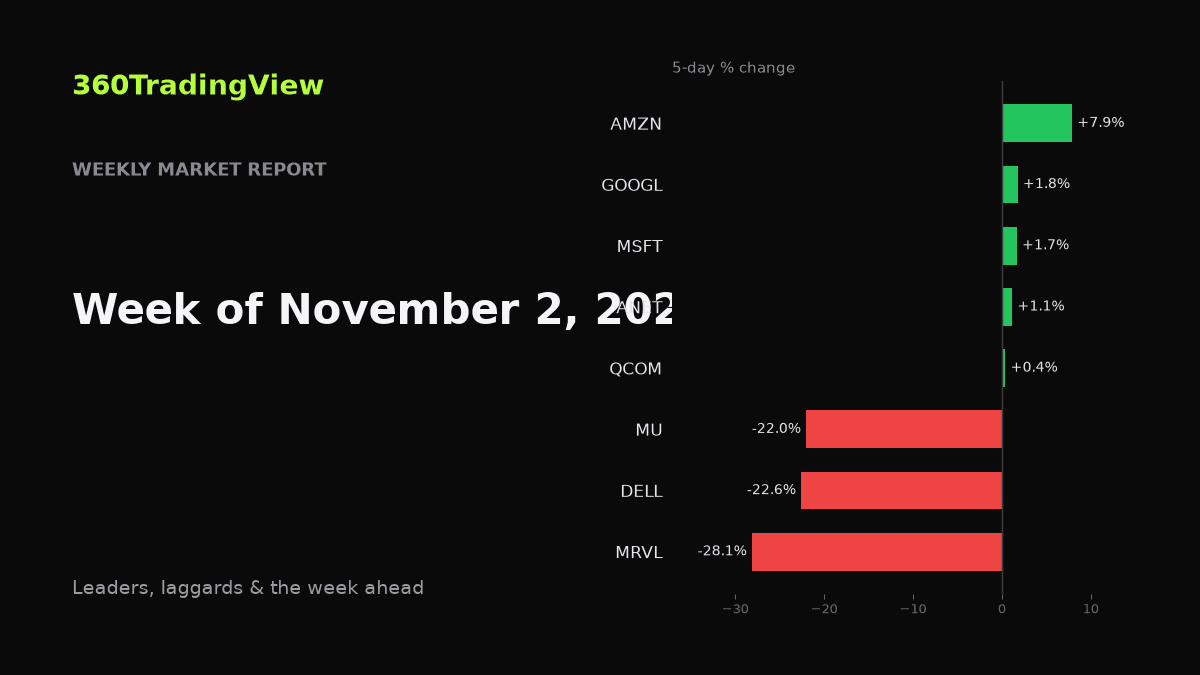
This week delivered a sharp bifurcation within the AI complex: mega-cap hyperscalers advanced while the AI hardware supply chain — memory, networking peripherals, server OEMs, and semi-cap equipment — sold off violently. The tape suggests investors are re-underwriting who captures the economics of the AI buildout, favoring platform owners over capital-intensive enablers. The dispersion (Amazon +7.9% vs. Marvell -28.1%) implies a nearly 36-point spread in a single week, a magnitude typically associated with a thematic re-rating rather than ordinary rotation.
Market Dynamics
Leadership concentrated in hyperscale platforms with monetizable AI demand: Amazon (+7.9%) led decisively, with Alphabet (+1.8%) and Microsoft (+1.7%) following. The signal is that end-demand aggregators — those able to pass AI capex through to cloud, ads, and enterprise software revenue — retained bid. Notably, Arista (+1.1%) was the sole hardware name positive, a reminder that networking tied directly to hyperscaler spend held up far better than merchant silicon and OEM peers.
Laggards tell the inverse story. Marvell (-28.1%), Micron (-22.0%), and Lam Research (-16.2%) paint a memory-and-equipment unwind; Dell (-22.6%) and Vertiv (-21.4%) extend the de-rating into server OEMs and power/cooling. When five of the largest AI-exposed hardware names decline more than 16% in a single week while their customers advance, the market is typically repricing margin durability, inventory risk, or the perceived defensibility of pricing power — not questioning AI demand itself.
Exhibit 1 — Weekly performance, selected names (5-day % change)
| Ticker | 5-Day | Read |
|---|---|---|
| AMZN | +7.9% | Leader |
| GOOGL | +1.8% | Leader |
| MSFT | +1.7% | Leader |
| ANET | +1.1% | Leader |
| QCOM | +0.4% | Leader |
| MRVL | -28.1% | Laggard |
| DELL | -22.6% | Laggard |
| MU | -22.0% | Laggard |
| VRT | -21.4% | Laggard |
| LRCX | -16.2% | Laggard |
Rates and mega-cap behavior reinforce the read: mega-cap tech was resilient while longer-duration, higher-beta capex beneficiaries were sold. That pattern is consistent with investors trimming exposure to names where forward estimates have moved fastest and valuations compressed least.
Sector Read-Through
Semis — dispersion, not de-rating of the theme. The split between Qualcomm (+0.4%) and Micron/Marvell/Lam (down 16–28%) suggests the selling is targeted at memory cyclicality and capex-sensitive equipment, not broad semiconductor exposure. Historically, memory leads both directions; this week's move warrants attention as a potential tell for the broader cycle.
AI infrastructure — the "picks and shovels" trade repriced. Vertiv (-21.4%) and Dell (-22.6%) had been proxies for AI power, cooling, and server demand. Their magnitude of decline, alongside Arista's modest gain, suggests the market is distinguishing between hardware vendors with hyperscaler-anchored backlogs and those exposed to broader enterprise or merchant dynamics.
Mega-cap platforms — the relative-safety trade. AMZN, GOOGL, and MSFT functioned as the week's defensive AI exposure. In a week of hardware disruption, scaled free-cash-flow generators were where capital hid.
The Week Ahead
Three items worth monitoring as an educational framework:
- Follow-through in memory and semi-cap equipment. Whether MU and LRCX stabilize or extend losses will inform whether this week was a position unwind or the start of a cyclical reassessment.
- Hyperscaler capex commentary. Any directional shift in AWS, Azure, or Google Cloud capex guidance would directly affect the enablers that led this week's declines.
- Rate-sensitive dispersion. Watch whether mega-cap resilience broadens or narrows; a narrowing would suggest crowding risk in the week's winners.
None of the above constitutes a forecast — these are observation points for framing next week's tape.
Key Takeaways
- The AI trade is bifurcating: platform owners up, hardware enablers down sharply.
- A ~36-point one-week spread between AMZN and MRVL signals thematic repricing, not noise.
- Memory and semi-cap equipment weakness warrants monitoring as a potential cycle signal.
- Networking tied directly to hyperscaler spend (ANET) outperformed other hardware — specificity matters.
- Mega-cap tech again served as the market's defensive posture; watch for crowding.
Educational only. Not financial advice.