Weekly Market Report
Executive Summary
Mega-cap software and hyperscaler platforms decisively outperformed this week, while the "picks-and-shovels" AI hardware complex — semiconductors and power/cooling infrastructure — sold off sharply. The rotation suggests capital is migrating from AI capex enablers toward AI monetization beneficiaries, a meaningful shift in how the market is pricing the next leg of the AI investment cycle. For allocators, the dispersion inside a single thematic tape is the story: "AI" is no longer trading as one trade.
Market Dynamics
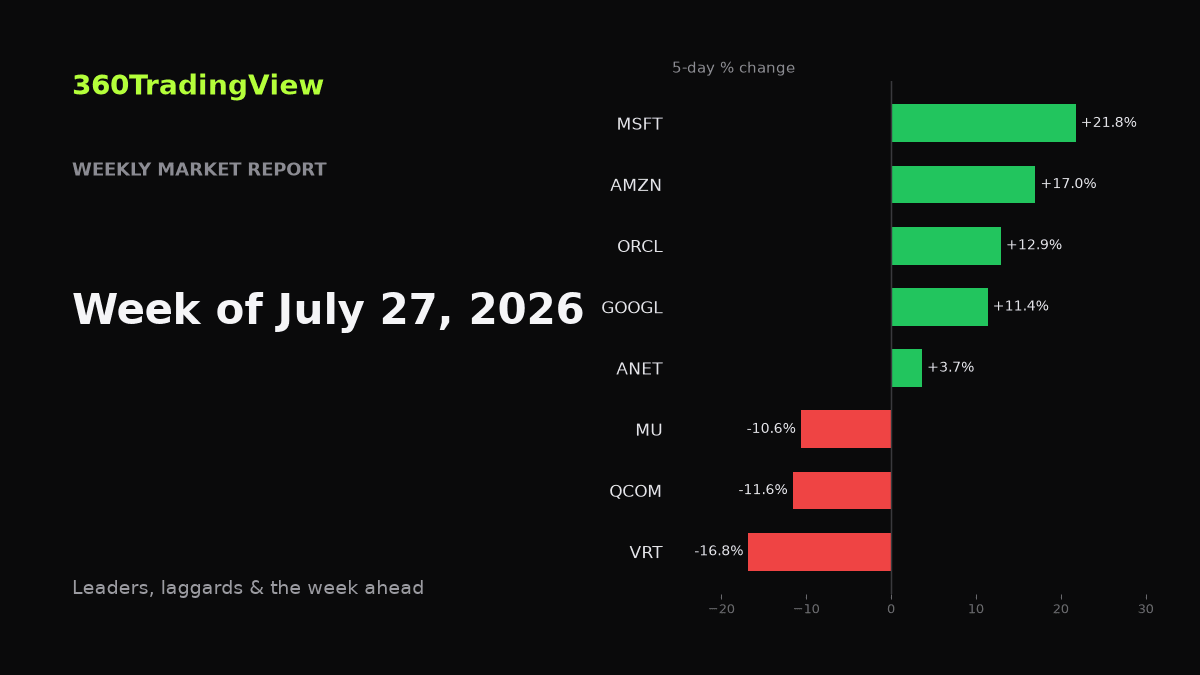
The week's leadership was concentrated in cloud and platform mega-caps. Microsoft (+21.8%) and Amazon (+17.0%) led, with Oracle (+12.9%) and Alphabet (+11.4%) close behind — a clean sweep of the U.S. hyperscaler cohort. The read: investors rewarded companies positioned to monetize AI workloads through cloud consumption and enterprise software, not those selling into the buildout.
Laggards told the opposite story. Vertiv (-16.8%), the data-center power and thermal proxy, was the week's worst performer. Semiconductor names followed: Qualcomm (-11.6%), Micron (-10.6%), and AMD (-8.8%). Arista Networks (+3.7%) was the notable exception on the hardware side — its modest gain reinforces that networking tied directly to hyperscaler spend was treated differently than merchant silicon or power infrastructure. Robinhood (-8.8%) rounded out the laggards, hinting at some pressure on retail-flow-sensitive names alongside the risk rotation.
Exhibit 1 — Weekly performance, selected names (5-day % change)
| Ticker | 5-Day | Read |
|---|---|---|
| MSFT | +21.8% | Leader |
| AMZN | +17.0% | Leader |
| ORCL | +12.9% | Leader |
| GOOGL | +11.4% | Leader |
| ANET | +3.7% | Leader |
| VRT | -16.8% | Laggard |
| QCOM | -11.6% | Laggard |
| MU | -10.6% | Laggard |
| HOOD | -8.8% | Laggard |
| AMD | -8.8% | Laggard |
The pattern is consistent with a market re-underwriting the return on AI capex rather than the volume of it. When platform owners rally 11–22% while their suppliers fall 9–17% in the same five sessions, the implicit message is that pricing power and operating leverage sit further up the stack.
Sector Read-Through
Hyperscalers and mega-cap software. MSFT, AMZN, ORCL, and GOOGL all posted double-digit gains — an unusually synchronized move. This is a bet on cloud consumption inflection and margin durability, not a broad tech rally. Notably, the strength was contained to platform owners with direct enterprise AI exposure.
Semiconductors. The divergence between MU, AMD, and QCOM (all down ~9–12%) and the hyperscalers they supply is the sharpest cross-current of the week. Memory (MU) and merchant compute (AMD) took the brunt, consistent with concerns about pricing, inventory, or capex pacing rather than end demand collapse.
AI infrastructure and power. VRT's -16.8% is the standout. As a pure-play on data-center power density and cooling, the magnitude of the decline suggests the market is stress-testing the "unlimited buildout" narrative. ANET's mild positive move (+3.7%) shows the selling wasn't indiscriminate across infrastructure — networking held up better than power.
The Week Ahead
Investors monitoring this rotation may want to watch whether hyperscaler strength broadens or narrows in the coming sessions — sustained leadership from platform names typically requires follow-through from adjacent enterprise software. On the hardware side, the key educational question is whether semis and power names stabilize or continue lower; a bounce would suggest this week was positioning-driven, while continued weakness would point to a more durable re-rating. Any commentary from hyperscalers on capex trajectory, and from semiconductor names on order books, will be relevant context. Volatility around single-stock earnings and macro data releases should be expected given the magnitude of intra-theme dispersion.
Key Takeaways
- "AI" split into two trades this week — monetizers outperformed enablers by 20+ percentage points at the extremes.
- Hyperscaler synchronization is unusual; MSFT, AMZN, ORCL, and GOOGL rarely move together in double digits without a common catalyst re-rating the group.
- VRT's -16.8% is the tell on AI-capex sentiment — power and cooling led the infrastructure drawdown, not networking.
- Semiconductor weakness was broad but not uniform — memory and merchant compute lagged; ANET's resilience shows selective demand.
- Dispersion, not direction, is the risk-management issue — thematic baskets masked significant single-name divergence this week.
Educational only. Not financial advice.